


Interview with Albert Martí Carreras, co-owner of Mosaics Martí
Today we talk to Albert Martí about mosaics, a constructive element that in the last century has marked both the city of Barcelona and the life of his family thanks to Mosaics Martí, the company founded by his grandfather.
What is Mosaics Martí dedicated to?
.You are a historical company in the sector... When was Mosaics Martí founded? How has the company evolved?
Perhaps it is very daring to talk about a historical company, but in any case we have existed for more than 100 years and only for that reason we are already part of history... even if it is a little, right?
Our grandfather, Bernat Martí Arlandis, with Valencian origins, opened the family workshop, in Manresa, in 1913. In fact, his grandfather, who was another emigrant to Barcelona at the time of the Universal Exhibition of 1898, had his first contact with hydraulic mosaics working for a time at the prestigious Casa Escofet, until he had enough financial capacity to open his own workshop.
Since its foundation (1913), Mosaics Martí has been a family business linked to the production of hydraulic mosaics, but over the years also to materials for construction. His son and our father, Pere Martí, opened in 1950 one of the first warehouses of materials for the construction of Manresa, and also dedicated himself to the manufacture of batons and precast concrete, when the Hydraulic Mosaic began to decline between the years 1950 and 1980. It was at the end of the 80s that my brother Pedro and I decided to produce hydraulic mosaics again.
Can you tell us a little more about mosaics? What are they made of? How are they made? Is it an industrialized or artisanal process
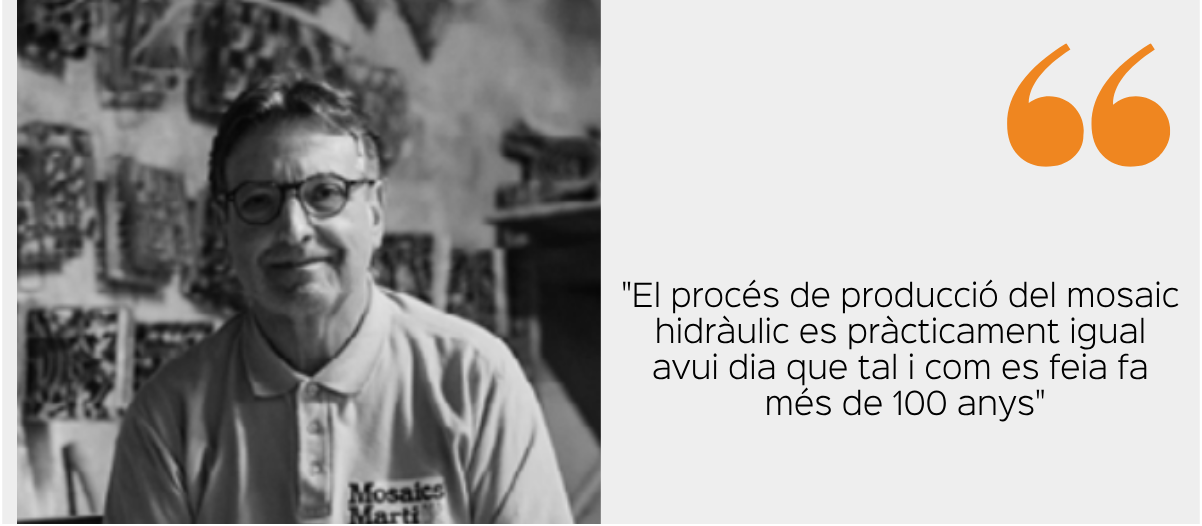
?Hydraulic mosaic is a cement tile. But a cement tile with very special characteristics, both in the raw material (cements, aggregates and natural pigments), and in its production process, which is practically the same today as it was done more than 100 years ago
.Its production process involves white and Portland cements, marble and sand aggregates and pigments of natural colors. The process is artisanal, although it requires machinery and tools that makes us speak of a pre-industrial process. The mosaic craftsman has a mold, made up of three pieces, which are base, belt and cap; and uses the climbers, to be able to make the characteristic drawings of the mosaics
.
The interviewee (left) and Jaume Torrejón, mosaic craftsman and current head of the Mosaics Martí workshop
Can you tell us how the mosaic has evolved in Catalonia in general? What social and cultural use does it have?
The hydraulic mosaic in Catalonia has a reference period, around modernism. In fact, there are not many situations like this in which a product such as mosaic finds in a cultural reference, Modernism, the ideal place to develop and offer itself so successfully that it has ended up being recognized worldwide.
The architects of Modernism drew the mosaics, which the manufacturers of the time produced and placed on the pavements of the most emblematic houses. Although it is also a product that extends to all types of construction, as can be seen in the amount of m2 of mosaic that we find in constructions for more than 100 years, and that today, they still shine in all their splendor. Today we produce mosaics practically the same as we did more than 100 years ago, with the advantages of raw materials (cements, aggregates, pigments...) undoubtedly much better than before.
Has the current activity and way of doing business changed a lot compared to the one used by your grandfather?
More than 100 years have passed and logically many things have changed, but as I said before, we in the workshop produce with the same presses, molds and tools of the grandfather.
As for the product, before a series of models were produced where few variations were considered, and today, the great value of the mosaic is that we are talking about an artisan product, produced piece by piece, which allows us to make very personalized productions. And this means that our customers can enjoy unique mosaics for their home.
How important are mosaics within the life and history of a family of generations dedicated to mosaics?
As you can imagine, in our family mosaics are another element of everyday life and it would be difficult to separate the Martí family from Mosaics Martí. And more, taking into account the years we are talking about, with everything that the country has experienced (revolutions, dictatorships, war...). We, the third generation were born having the workshop under house and therefore it was the place of our games as children and of course, our learning
.For years in Barcelona, the architecture of the buildings seems very oriented towards minimalist and monochromatic spaces. How does the mosaic fit into this perspective? What demand do you have today?
This is a reality that is confirmed, although in these times we have worked producing mosaics with very neutral colors. For two or three years we have noticed how color is returning and that makes us very happy, although perhaps it does not return in designs, let's say more floral or modernist, but in more contemporary visions. Architects and interior designers appreciate the ability to personalize mosaics and we are working both in the private sphere and in public spaces (hotels, restaurants, shops...). In the workshop we say that we make mosaics of contemporary aesthetics with a technique of the 19th century.
In 2021 you receive the National Craft Award. We congratulate you from the Guild, we admire your work very much. What does this award mean to you?
In November 2021 we received the news of the awarding of the National Craft Award 2021. I remember with emotion the moment when they informed us, because as you can imagine, in a few seconds a lot of memories passed through my head, of those of us and above all, of those who are no longer there. Also of everything the family has experienced, what is good and what is not so good, for today, 110 years later, to be here, producing what the grandfather produced, the hydraulic mosaics.
We thank you for the congratulations and let me say, too, that there is no more pride that your own country recognizes you.
What is the future of mosaics? What about Mosaics Martí?
I believe that hydraulic mosaic, as a very particular product, surely far from being a mass consumer product, still has an important future. In the workshop, we work closely with construction professionals, architects, interior designers, builders... who see mosaic as an opportunity for its ability to personalize, both in designs and colors
.And in relation to the company, although in the coming years the Martí family will no longer be at the forefront, it has a good future, thanks to the human team that makes it up; and as long as possible, it will have the support of the family.
Access the interview and other content of interest to the sector in our magazine

The interviewee (on the right) and his brother Pere Martí Carreras). Official photograph of the awarding of the National Craft Award 2021, presented to Mosaics Martí.