


Interview with Pilar Almagro Marcos, CEO of VertiSub Internacional, about company expansion and international experience
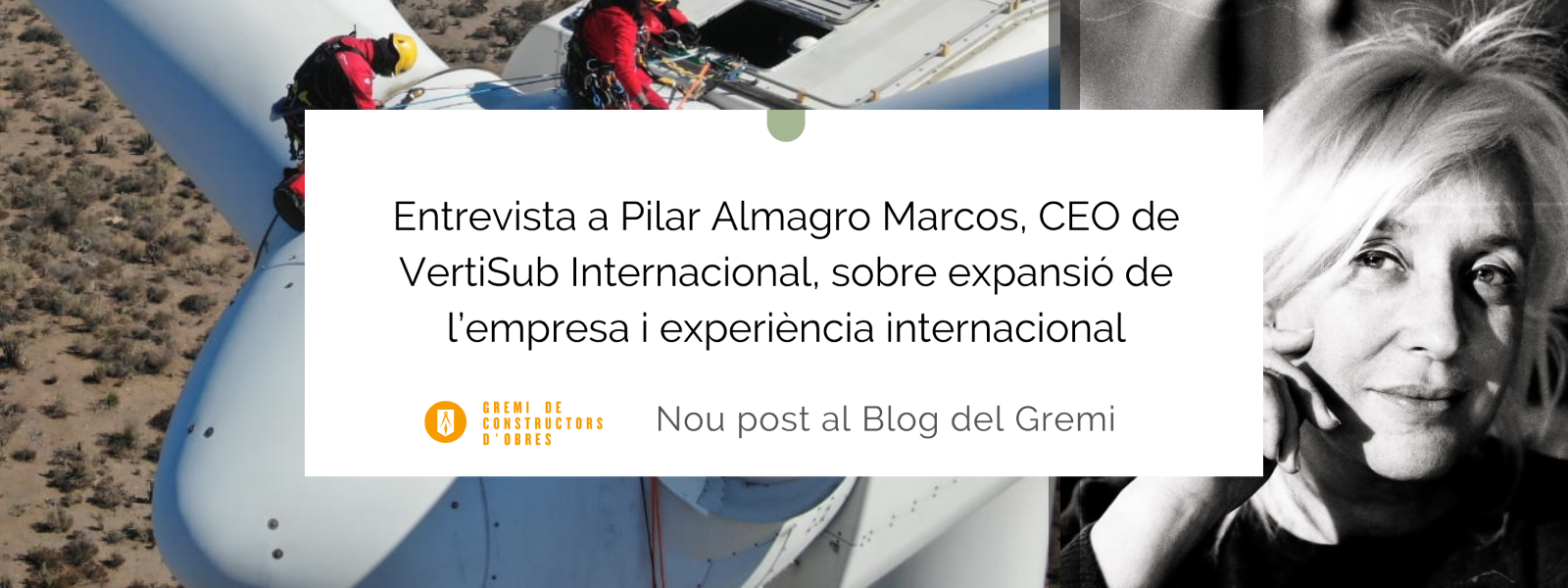
In this issue of the magazine we interview Pilar Almagro, an interesting businesswoman in the sector and who, following the economic crisis of 2007, expanded her company around the world, with a strong presence in South American countries. We interviewed him to ask him about his vision of the sector as well as his international experience
.-Vertisub is now a multinational company with roots in Barcelona with a presence in countries such as the United Kingdom, Chile, Colombia, Peru, Guatemala and Uruguay... How did you move from a local company in Barcelona to work in different countries? What does such an expansion require
?Vertisub started in Barcelona. We saw that there was an empty ecological niche. We could access anywhere with ease and security, and once here, do the job. Before us it was very expensive and risky to carry out certain works, such as cleaning and repairing the interior of a silt in an explosive environment, removing waste from the secondary circuit of a nuclear power plant, making disc changes in the Barcelona metro tunneling machines or embellishing the statue of Columbus
.Well, given the crisis that we suffered at the end of 2007 in Spain, with a sudden drop of 70% in sales and delays in payments of the large companies for which we worked, I thought that we could do two things: either sell new things in the same place (Spain) or sell the same in other places (the world) I opted for the second option, without ruling out the first, and today Vertisub is a group of companies that provide unique solutions to complex problems in risky environments.
As you can see, we do not fit into any specific niche, however, we are the best in some of them, such as in wind turbine and hydroelectric maintenance, being leaders in South America. This vision of what the company does keeps us in constant tension. Tension between what lifts us up and what sinks us. Tension to hold the rope on which to balance. This is also called innovation.
When I left, first to Chile, they wished me luck. I already counted on her, because the “there is no other remedy” works. Many things are done because “there is no other way”.
Such an expansion requires desire and an open mind to understand very very quickly the idiosyncrasy of the people of the new place... otherwise you will not be able to sell. And finally, it forces you to be there, taking care of everything, from the everyday to the greatest
.Many companies have failed in their expansion because they have not gone to lead who played it, but they have sent someone who was not playing at all. I, upon arriving in each country, was going to live there, I was not in traffic. I myself looked for rent, people to work with, my daughter's school (I took my 16-year-old daughter with me) and visited clients. I was also enrolled in a good university and enrolled in philosophy and constitutional law subjects to understand the basis of shift country law. In this way, in a short time I was in a position to understand what customers in this country needed
.-How is the sector in these other countries where you work? Are there many differences between one country and another?
The biggest difference I have found between countries is in the perception towards the employer. The harassment that exists in Spain against the self-employed and the entrepreneur does not exist in other countries. Only 45% of Spaniards believe in a free market economy. This is key, because beliefs determine our actions.
Here, the laws, society and the family itself, greatly penalize the entrepreneur. If you do well it will be because you are an exploitative. If it goes wrong, you deserve it. If you are a woman, even worse. However, the social perception of women entrepreneurs has improved a lot, but not so that of entrepreneurship
in general.In Chile the construction is magnificent and the vision towards the entrepreneur too. You just have to look at how buildings resist the effects of earthquakes in the most seismic country in the world. I experienced an 8.2 Richter scale earthquake in my 30th floor apartment and only one book fell. In Colombia there is a lot of corruption in construction, especially infrastructure. In Peru there is a lot to do, it is a country of enormous possibilities in which the vision of the old patron still persists.
- How are you living all this social, economic and health crisis?
We'll get out of this. Despite the losses caused by the forced inactivity of the pandemic, we will end up positive in most countries, which is a success
.On the other hand, it is a tremendous opportunity to change the business model. We cannot continue with structures and legislation of the 20th century in the face of a reality of the 21st century. In the 20th we lived in a Biopolitical society, which in the 21st has mutated towards a Political Psycho, according to the thinker Byung-Chul Han
.It seems to me that to achieve the change we need we must transform the social gaze towards the social reality that is the company. In the following table we can see differences between the Bio-companies of the 20th century, which mainly employed labor, and the Psycho-companies of the 21st century, which no longer want growth but optimization, and which are obliged to understand each other with the new protagonist, Artificial Intelligence: