


Interview with Salvador Guillermo, Deputy Secretary General for the Promotion of Work
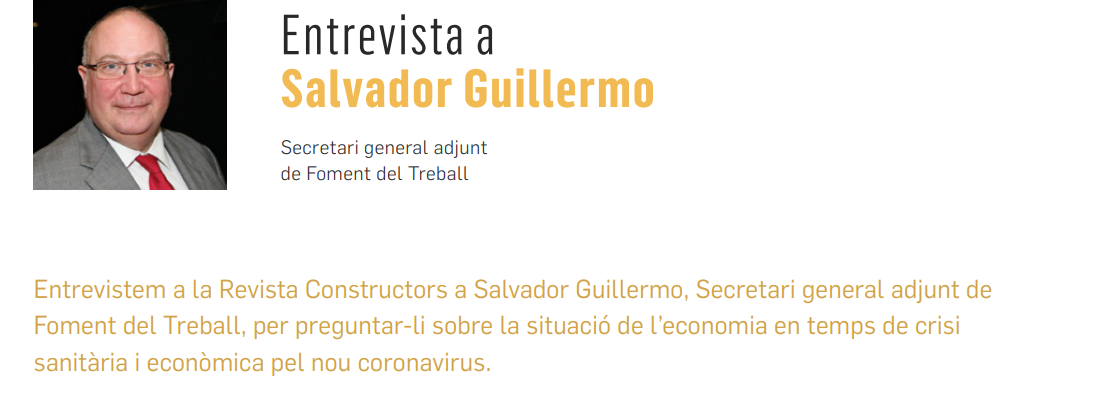
In the Constructors Magazine last December we published an interview with Salvador Guillermo, Deputy Secretary General of Labor Promotion, to ask him about the situation of the economy in times of health and economic crisis due to the new coronavirus.
- What has been and is the bill to the Spanish and Catalan economy of Covid-19 and the containment measures? How do you think the economy will evolve in the coming months?
The bill is very significant. In addition, and unlike other nearby countries, the fall in employment is very intense in our country, and therefore, it must be added that if the appropriate support measures are not adopted we can also have a social crisis
.Likewise, all forecasts point to future improvement, since this second wave of the pandemic may reduce this recovery, once the confinement is over.
- How are we going to get out of here? What needs to be done to recover the best and as soon as possible?
We must be aware that the crisis is deepening, but also temporary, due to restrictions on activity and mobility. For all this, it is essential to give as much support as possible to the economy and the sectors affected by the public sector, so that they quickly recover, once the health crisis has been overcome, the speed of growth they had before. It should not be forgotten that other countries have given more direct aid, and also
more lines of credit.- Will there be a change in the economic structure of our country? In what sense?
Any change implies the need for adaptation. The previous crisis, which was real estate, meant a sharp drop in activity in the sector. Here there are more structural changes, derived from greater digitization, which will affect commerce, education or health, among others, where the digital path is entering in an accelerated way. It also affects the environmental sustainability factor. For example, it is necessary to foresee greater activity in rehabilitation, especially with the greatest aid for energy efficiency issues.
- What are the most significant weaknesses of our economy in the current situation? And the strengths?
One of the weaknesses, could be, the lack of strong governments, which are always necessary, and even more so in delicate moments. That is why the cry to all political forces for the search for a great agreement (in which everyone loses to win everyone), without apriorisms that hinder dialogue, negotiation and pact. If it is not possible in all areas, at least it should be in the Economic and Social Agenda to get out of the turmoil we currently have. The strength is people, the capacity for resilience and the ability to undertake, but we cannot do it alone. I always remember the fear of the European market in our integration into the EU, and it was a success story where our people, or a large part, made
it possible.- Where is the balance between social spending and investment?
They are not opposites. Recently the International Monetary Fund points out the need for investment, and specifically public investment, to reactivate the economy, and by reactivating the economy we will solve part of the social question, and we will generate more income, through taxation, to pay social spending
.Now it is a binomial, but it is necessary to strengthen the reactivation, because the machinery has stopped to attend to health issues, and it will be time to start it again.
- How do you think European aid will be channelled into the construction sector?
Based on the European guidelines on where the extraordinary funds should go, it seems that they will serve especially for rehabilitation (and more specifically that associated with energy efficiency) and for more sustainable public works, such as, for example, neighbourhoods, or equipping infrastructure for electric vehicles.