


Report on the situation of construction in Catalonia
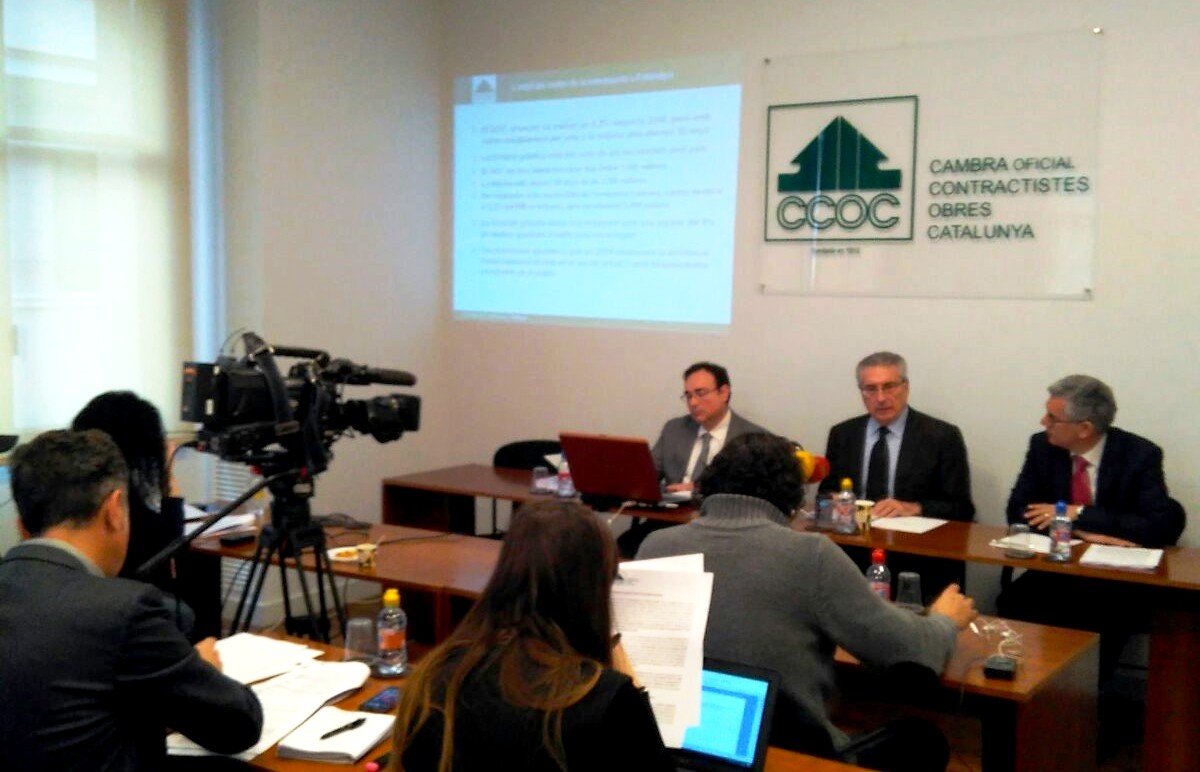
On Wednesday 21 December, the Official Chamber of Works Contractors of Catalonia presented a study on the construction sector in Catalonia during the past 2017, as well as the forecasts and recommendations for this 2018.
Joaquim Llansó, President of the Chamber, was in charge of presenting a study of the economic situation which indicates slightly positive statistics in the different areas, with an overall growth of 5.3% compared to 2016, but which represent absolute values “significantly below the average of the last 20 years”.
According to the study, the 1,690 million euros of public tenders last year, despite representing an increase of 559 million compared to 2016, are still sharply lower than the 2.2% of Catalan GDP that is needed, being also well below the average public investment of the last 20 years, which stands at 3,750 million euros.
Therefore, according to the CCOC, “we cannot speak even though we are in a process of recovery of activity, but the effects of the crisis are still well present”.
Regarding the origin of public investment, the report highlights how the growth in 2017 is given by the municipal elections of 2019, since the local administration increased the volume of tenders by 496 million, presenting a demand for supply of 1,046 million euros, which represents 62% of public activity.
On the other hand, the Generalitat increased investments by 128.5 million, to a total of 426 million euros, and the State on the other hand reduced its expenditure by 66 million, remaining in an investment of 218 million euros.
Likewise, the CCOC indicates that public investment in the Eurozone was 2.7%, while in Spain it remained at 1.9%.
Investment in public works in the Eurozone was 2.7%, in Spain 1.9% Share on X Other indicators
The CCOC report also puts on the table other relevant data of the sector in Catalonia, such as the 13.1% increase in employment in the sector according to the EPA, reaching a total of 208,500 people, although it should be borne in mind that 240,000 jobs were destroyed in 2007 alone.
On the other hand, it is remarkable how of the 47,869 construction companies existing in 2008, in 2017 there are 22,621, in a market that is growing moderately atomically, with 96% of companies with less than 10 employees.
Of the new construction, we find an 11.4% increase compared to 2016, with a total of 16,579, 19% compared to 2007, while the reform and extension has decreased by 3% compared to 2016.
Prospects and recommendations
According to the estimates of the Euroconstruct Report, the sector is expected to continue to rise, by 3.8% during 2018. The 2019 municipal elections are also expected to increase public spending.
Likewise, with the situation described and foreseen, the CCOC presented a series of measures to promote the normalization of the sector: reaching 5 billion annually in public investment (2.2% of GDP); prioritizing infrastructure according to demand; simplifying and homogenizing procurement procedures; not counting strategic investments co-financed by the EU into the deficit, establish pay-as-you-go on high-capacity roads; boost public-private partnerships, and promote the conservation and maintenance of infrastructure , as well as the rehabilitation of buildings with a view to the commitment to reduce CO2 emissions by 20% by 2020
.