


Some conclusions from the debate on challenges of business organizations...
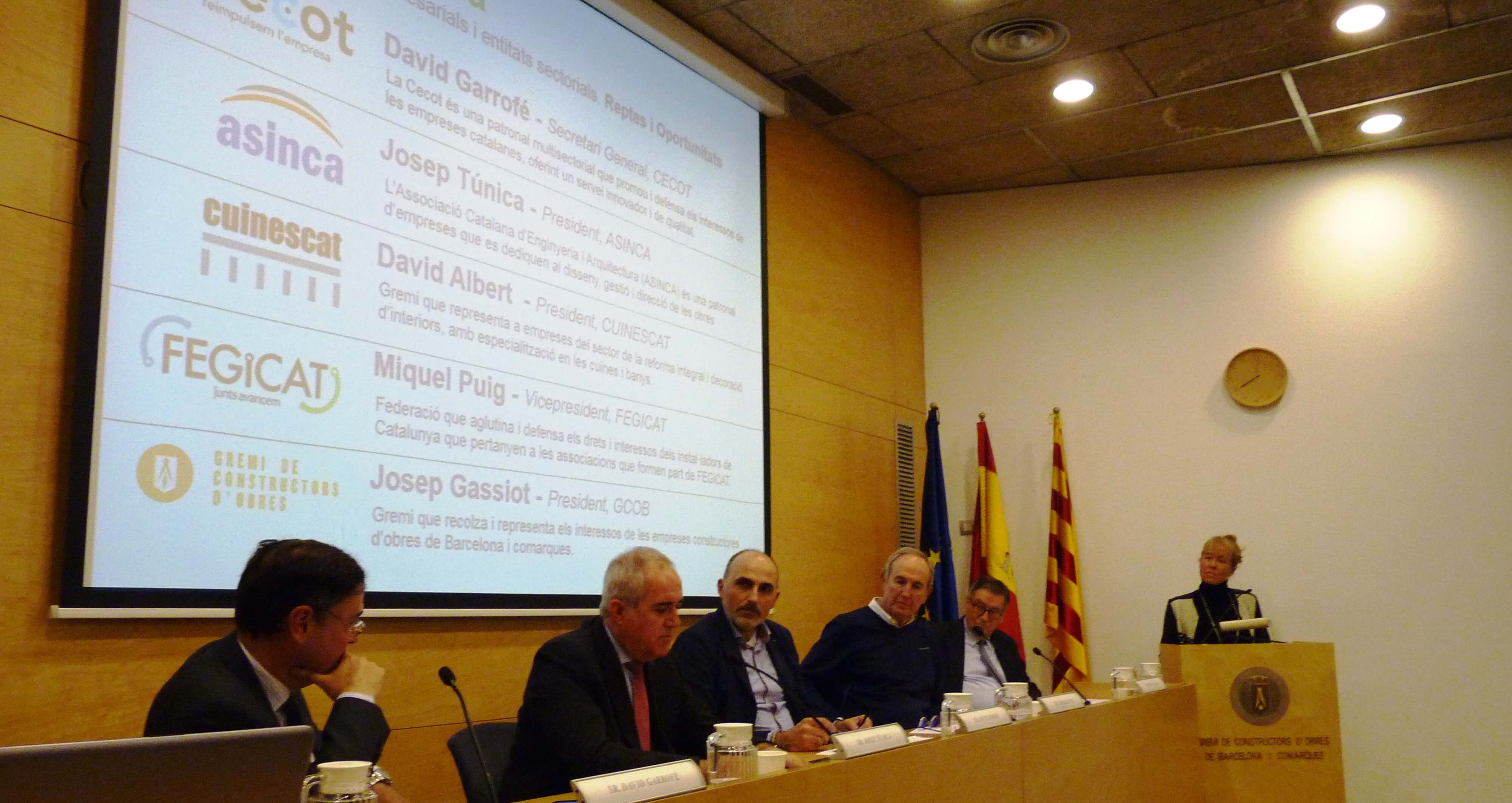
Last Thursday, December 12, from 7:30 p.m. to 9 p.m., an interesting debate took place at the Guild's premises with the title “Business organizations and sectoral entities. Challenges and Opportunities”; and with the participation of David Garrofé (Secretary General, CECOT), Josep Túnica (President, ASINCA), David Albert (President, CUINESCAT), Miquel Puig (Vice President, FEGICAT) and Josep Gassiot (President, GCOB)
.Moderated by Mercè Polo, manager of the Builders' Guild, we had the opportunity to listen and discuss aspects related to the situation, mission and objectives of organizations, the existence of conflicts of interest between entities, the role of public administrations, new perceptions and priorities of companies, new trends and functions to promote associationism, etc.
Many diagnoses and challenges emerged from the session in order to strengthen associationism. We highlight the following:
- The associationist tradition of Catalonia has given rise to a large number of associations in our own, which requires finding common points and shared strategies to gain the capacity to influence and support the business fabric
- Business entities today not only serve to support companies but also to promote and sensitize them in relation to social responsibility practices.
- The administration should value more the role of partnerships as transmission levers between itself and companies, in matters of regulation, agenda or social sensitivity. In this sense, partnerships with professionals are necessary, and this has a cost that must be assumed by all
- The creation of committees and meeting points between organizations and entities is more necessary than ever, in order to bring together the different voices and prepare common strategies.
- Associations must seek to make their functions and senses more visible, as well as continue to look for what to offer that can be of value to companies. Just as training or funding had been pillars of partnerships, it is necessary to constantly look for new ones.
- There is a certain crisis in associationism due in part to the fact that many companies only want to join in exchange for benefits and direct economic gains, not so much to maintain a representative voice or to belong to an entity that brings together their professional collective. Another reason is of a more cyclical nature, due to the discredit suffered by employers together with other actors such as trade unions or political parties, probably largely due to a generalized social dissatisfaction with living conditions, and more specifically
- In other countries, business organizations receive much more support from the administration. This is a path that perhaps needs to be defended
- Attracting young people is the biggest challenge. We must give them a voice and mold ourselves to their values, ways of doing things and needs. Cal will vindicate associationism to promote the values of professionalism, work well done and corporate social responsibility. A sector with shared values is a healthier sector and consequently a more profitable sector in the long term