


Summary of the RiME Conference of 15/12/2022
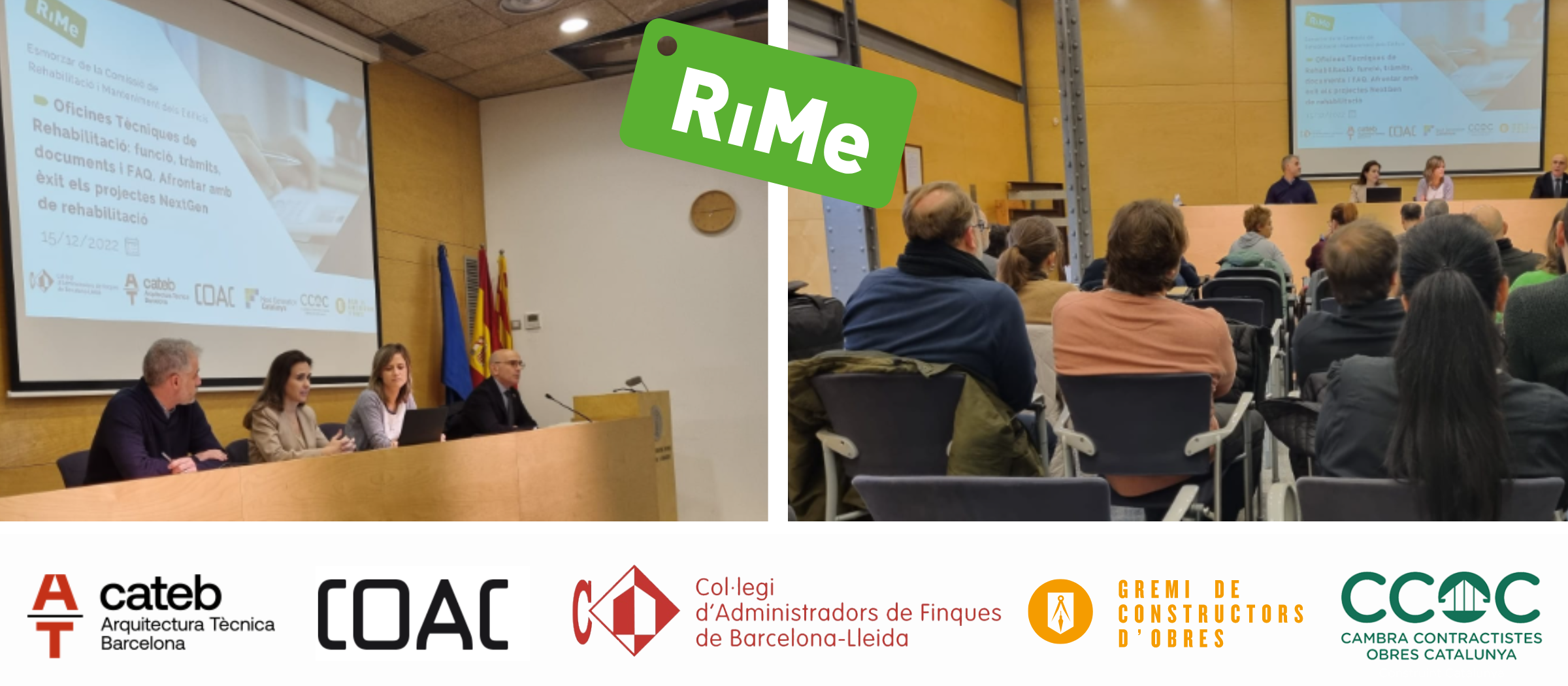
Theme of the session: Technical Rehabilitation Offices: function, procedures, documents and FAQs. Successfully face NextGen rehabilitation projects
On the morning of Thursday, December 15, a new day/breakfast was held by the Commission for the Rehabilitation and Maintenance of Buildings (RiME) aimed, on this occasion, to deal with the operation of the Technical Offices of Rehabilitation and to report on the financing and tax benefits obtained by taking advantage of the Next Generation subsidies for the energy rehabilitation of houses and buildings.
The meeting took place in the auditorium of the Guild headquarters between 9 am and 11 am and began with the welcome and thanks to the participants and speakers by Josep Antoni Martínez Zaplana, president of the Guild who opened the day with the reading of the Editorial of the Guild magazine, recently published and closely related to the theme of the session. Martínez stressed that we are one year away from the end of the deadline for submitting applications and that a lot of outreach and awareness work is still needed, since “if a need is not detected, a community does not
consider solving it.”Part 1: Presentation of the Technical Rehabilitation Offices (OTR). Function, procedures and documents. Frequently Asked Questions
.In the first part of the day, Marta Martínez Tomàs, coordinator of the OTR of the Col·legi d'Arquitectes de Catalunya (COAC), recalled that the Next Generation grant in building seeks to meet the European objectives of transition towards a more energy sustainable economy, and for this reason it makes available 6.820 million euros for the rehabilitation of homes, buildings and neighborhoods.
In this sense, and with the intention of favoring and promoting the European programs of the Next Generation Funds, it was indicated that two new figures appear. On the one hand, the Technical Rehabilitation Offices (OTR) were born with the aim of supporting both professionals and citizens. In collaboration with the Housing Agency, they are responsible for reviewing the reports of technical suitability assessments of the applications. The other emerging figure is that of the Rehabilitation Agent as a professional responsible for the integral management of the rehabilitation process, coordinating all the agents involved in the process
.In this framework of explanation, Victor Forns Rodelas, coordinator of the OTR of the Association of Property Administrators of Barcelona and Lleida (CAFBL), referred to a particularity of its administration and that is that they do not have the obligation that there is the figure of the property administrator at the back, as is necessary that of the technical architect in the other OTR, but they give welcome to any representative who wants to carry out the procedure. For this reason, the relevant information to carry out the file procedures has been made available on the website of the Technical Rehabilitation Office of the College of Administrators
.Subsequently, Eva Bonet Forero, coordinator of the OTR of the Consell de l'Arquitectura Técnica de Catalunya insisted on the common objectives of OTR to facilitate communication between administrations and collegiate technicians. Likewise, Bonet stressed that it is necessary to internalize the precept of 'renovate energetically' and that is why it is necessary to train technicians and change their way of thinking when including structural pathologies of the building in their reports: “If a building is not properly insulated, it would have to be considered as a pathology at the conservation level “Atonement
.”In conclusion, all three OTR are at the service of dissemination and awareness in the field of rehabilitation and energy rehabilitation for both professionals and citizens, while promoting the training of their collegiate technicians so that they can guide citizens on the possibilities of their housing. More information can be found at https://rehabilitaresestalviar.cat/
-PWP presentation by Marta Martínez Tomàs
-PWP presentation by Víctor Forns Rodelas
-PWP presentation by Eva Bonet Forero
— Technical Office of Rehabilitation of the College of Architects of Catalonia
— Technical Office of the Consell de l'Arquitectura Técnica de Catalunya
— Technical Office of the Council of Colleges of Estate Administrators of Catalonia
Part 2: Financing and tax benefits.
At theend of this first part of the meeting, Victor Forns Rodelas, coordinator of the OTR of the Association of Estate Administrators of Barcelona and Lleida (CAFBL), takes the floor to explain that the regulations of the horizontal property law are governed by Book V of the Civil Code of Catalonia and that this has been modified with the intention of speeding up the decision-making process of communities of owners or multi-family buildings. The most important and outstanding is that from now on energy efficiency agreements can be adopted by a 'simple majority'
. Atthe fiscal level, he commented that Royal Decree-Law 19/21 of October 5 has two significant impacts. The first is that the amounts of grants received from the Next Generation Funds are exempt from taxation. The second is the creation of three new temporary deductions in personal income tax contributions for unsubsidized amounts invested. Forns pointed out that in order to qualify for these reliefs, cash payments are prohibited.
Finally, regarding the characteristics of the loans, Forns explains that these will be adjusted according to the type of recipient and may cover up to 100% of the investment made (including VAT). In the case of communities of owners, the loans will have a fixed rate that will not exceed 5.25% per annum for a period of 10 years of repayment. For individuals, the interest rate will be a maximum of 4% up to 7 years and for rehabilitative agents, the financing will be at a maximum rate of 5% for a period of 10 years. In the first and second cases, the repayment period may be extended until reaching 15 years depending on the guarantees, and in the third case it will also be possible to enjoy this extension of 15 years with a guarantee from Avalis and obtain a reduction in the interest rate of 1.15% if the mutual guarantee company guarantees the loan for a maximum of
12 years.Part 3: Various issues, debate turn and closing of the day.
Toclose the day, a space was left for the questions and/or doubts of the attendees and the session was concluded, again with gratitude for the attendance and participation by the president, as well as a special mention to the speakers for their collaboration and encouraging those present to “be promoters and agents of rehabilitation”. Finally, attendees were invited to enjoy a breakfast available to attendees as is the tradition of these RiME days
.