


Summary of the RiME conference on 23/03/2023
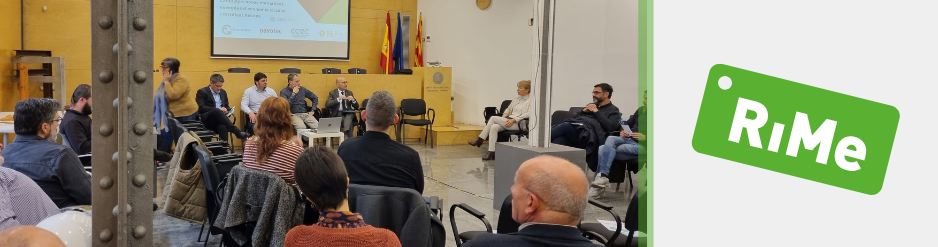
Topic of the session: The management of waste from rehabilitation works in Catalonia: new regulations, examples of circular economy and Recons certificate
In a new day of the Commission for the Rehabilitation and Maintenance of Buildings (RiME), held last Thursday 23 March at the Guild headquarters, the management of construction waste in Catalonia was discussed, “the great forgotten in the rehabilitation”, in the words of the president of the Guild, Josep Antoni Martínez Zaplana, who presented and moderated the session.
The attendees were able to learn from the hand of the technical architect Esteve Villarroya, from the technical department of the company Gestora de Runes de la Construcción (GRC), about waste management in rehabilitation works, as well as to listen to Daniel López, head of the Department of Environmental Consulting and Environmental Inspection of Applus in Catalonia and Aragon, explain the operation of the Reconnaissance certificate. Promoted by the Guild and the Chamber of Works Contractors of Catalonia as a certifier of good waste management.
First part: Waste management in rehabilitation works.
Recently, in the field of sustainability in the management of construction waste, a series of regional and state regulations have been adopted with the intention of regulating and promoting the circular economy, emphasizing that the sector must take a step further in the recycling of waste.
In this sense, Esteve Villarroya went back in time to explain how from the 1992 Olympic Games there were a series of demolitions in the coastal area that were not regulated and with which uncontrolled landfills emerged in the city. This led the administrations to approve in 1994 the first regulatory framework in relation to the management of construction waste in Catalonia through Decree 201/1994, of 26 July, regulating demolition and other construction waste. The Gestora de Runes, a company to which Villarroya belongs, is created based on this decree with the intention of arbitrating and managing the installation of deposits in the territory. During his presentation Villarroya placed on the map of the territory the different facilities that Gestora de Runes has been creating over the last 25 years in the different counties in order to facilitate construction companies to manage the waste from the works. We are talking about deposits, transfer plants (the farthest from the inhabited nuclei, where the waste of small producers is collected as a logistics point), recycling and restoration plants with land (the latter for large infrastructure works and need a large space). During 2022, the volume of construction waste that was managed from GRC has been almost 2 million tons.
Regardingthe evolution of the regulations, Villarroya indicated how in 2008 a further step was taken with the aim of promoting recycling with the approval of Law 8/2008, of July 10, which established a waste tax of 3.00 euros per ton of construction waste destined for the landfill, to penalize the fact that the material has not been separated and There is no chance of recovery. The money from this collection becomes managed by the Governing Board for Waste, created to control that all this money raised goes back to the sector, whether in the form of aid, subsidies, recycled aggregates or construction of recycling plants
.Villarroya completed this information with a series of graphs where he points out that based on this regulatory background, since 2001 the percentage of recycled materials has increased over the years to currently reach 60% with respect to all production, which after passing through the manager, returns to the sector in the form of recycled aggregate. From the Administration there is a desire to promote recycled aggregate, with which it was indicated in the Budget Accompanying Law of 2020 that “public and private construction construction construction projects must determine the use of recycled aggregates from the recovery of construction and demolition waste in a minimum percentage of 5% by weight of the total provided for, except that the characteristics of the work do not allow the use of this type of material, assumption that the author of the project must duly justify in the memory.” This regulation has subsequently been supplemented by Order ACC/9/2023, of 23 January, which regulates the use of recycled aggregates from construction and demolition and defines the types of materials that can make up the recycled aggregates and granulometries depending on the size of
the aggregate.Currently, the Waste Agency is working in collaboration with ITEC to prepare a campaign to publicize this latter Order aimed at the competent drafters of the projects and those responsible for the works directorates, as well as the local administrations that grant the licenses and other related agents.
Villarroya ended his presentation by stating the case of gypsum waste, which with Law 7/2022, of April 8, on waste and contaminated soils for a circular economy, establishes that from July 2022 waste must be classified in origin and separate fractions, including gypsum waste. Following these guidelines, the Runes Management Company incorporated an exclusive line for the recycling of plaster in the treatment plant they have established in Les Franqueses del Vallès
.—Presentation link for this part of the day
Part Two: RECONS Registration
After the first part of the session, President Josep Antoni Martínez Zaplana took the floor to point out that part of this waste collection rate is also allocated to aid for citizens in the removal of asbestos, an ambitious project that has been proposed by the Generalitat in a first phase of 8 years and a subsequent phase of 15 years of zero asbestos in Catalonia. This aid can be processed through the Waste Agency.
Once this point was indicated, Martínez Zaplana proceeded to introduce Daniel López, head of the Department of Environmental Consulting and Environmental Inspection in Catalonia and Aragon of the entity Applus, a company with great recognition in the sector for the integral management of assets and the most common regulatory inspections. López reported that the Recons seal, for certification of good construction waste management, is not only a certification but also has a consulting part where companies are provided with the appropriate information and training to carry out this waste management, with the subsequent inspection that the measures provided are correctly applied. In this way, the rehabilitator, thanks to this seal, can make visible to the client/citizen his environmental commitment and his correct waste management, the hiring of authorized agents of transport and management, and the legal compliance with the requirements for the correct management of waste. The client/citizen can verify on the website www.recons-consta.org, in a public and freely searchable list, that the company has the seal
.The Recons seal, implemented by the Private Foundation for the Planning of the Construction Sector in Catalonia, together with the collaboration of APPLUS/Novotec, in addition to promoting the improvement of environmental quality and the proper management of waste in construction sites, provides advantages to construction companies, for example in those tenders that request seals as requirements or environmental certificates, or in achieving a reduction in costs derived from the correct separation of waste and the recovery of capital that this Assumes in certain materials such as aluminum, iron, copper, lead, etc. In addition, explained Daniel López, there is greater security in terms of compliance with the regulations, thus avoiding the sanctions derived from environmental violations, specified in Law 7/22 of waste, for which the penalties can reach 3.5M euros.
In addition, the Recons certificate provides companies with a check of evidence of legal compliance that public grants require, as for example in the case of Next Generation grants, which only finance those projects that respect the principle of DNSH (Do no significant harm).
As a conclusion to his speech, López indicated the necessary requirements for the processing and obtaining of the Recons seal. Among the main requirements it should be noted that companies applying for this seal must dedicate all or part of their activity to the construction, renovation, maintenance and/or rehabilitation of homes in Catalonia, as well as have more than one year of professional experience. Interested companies can go to the website https://www.recons-consta.org/es/inscripcion to submit their application and find out about the documentation required to
provide.—Presentation link for this part of the day
Third part: Closing of the day and Networking
Closing the day, the president of the Guild, Josep Antoni Martínez Zaplana, highlighted the value that the Recons certificate offers to the company before the customer: “The seal is not only a document, it is not only the recognition that you know how to do it well... the seal is also the values of a company in relation to the recycling and environmental treatment of the materials we use”. The seal, he went on to explain, is of great help to those micro or small entrepreneurs to minimize the administrative processes that have such an impact within their own company.
Finally, the turn of questions was opened to clarify the doubts that arose during the interventions, encouraging attendees to later enjoy the breakfast prepared as is customary at the RiME conferences, and inviting those present to take advantage of this moment of relaxation to establish a small networking and share interests of the sector.