


We have a shortage of workers in the construction sector
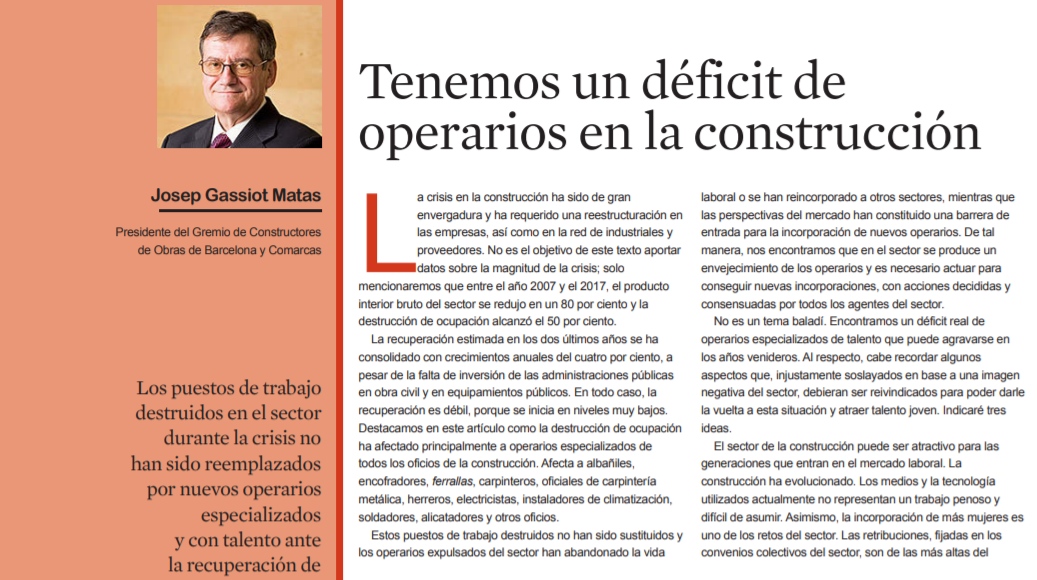
Recently the President of the Guild, Mr. Josep Gassiot, received the request to publish an article in the digital magazine Catalunya, by El Economista. In response to the request, the president has written an article indicating one of the problems of the sector, which may worsen over the years. We attach the article, which you can find published on pages 18 and 19 of the MAGAZINE CATALUNYA DE EL ECONOMISTA of the month of
July 2018.We have a shortage of workers in the construction sector
The construction crisis has been far-reaching and has required a restructuring in companies, as well as in the network of industrialists and suppliers. It is not the objective of this text to provide data on the magnitude of the crisis; we will only mention that between 2007 and 2017, the sector's GDP fell by 80% and the destruction of occupation reached 50%
.The estimated recovery over the last two years is consolidated with annual growth of 4%, despite the lack of investment by public administrations in civil works and public facilities. In any case, the recovery is weak, because it starts at very low levels.
We highlight in this article how the destruction of occupation has mainly affected specialized operators of all trades of construction. It affects masons, formworkers, “ironworkers”, carpenters, metal carpentry officers, blacksmiths, electricians, air conditioning installers, tilers and other trades. These destroyed jobs have not been replaced and workers expelled from the sector have left working life or reintegrated into other sectors, while market prospects have been a barrier to entry for new
workers.In this way, we find that in the sector there is an aging of operators and it is necessary to act to get new recruits, with decided and consensual actions by all the actors in the sector. It is not a trivial matter. We find a real shortage of skilled workers that may worsen in the years to come. In this regard, it is worth recalling some aspects that, unfairly ignored based on a negative image of the sector, should be vindicated in order to turn this situation around and attract young talent. I indicate three ideas:
The construction sector can be attractive to generations entering the labor market
Construction has evolved. The means and technology currently used do not represent a painful and difficult job to take on. Also, the incorporation of more women is one of the challenges of the sector.
The remuneration, fixed in the collective agreements of the sector, is one of the highest on the market, and at the same time the possibilities for promotion are high. For their part, companies in the sector require personnel who demonstrate responsibility and experience that is achieved more quickly than in other sectors. Therefore, responsible operators have a high chance of promoting themselves
.The construction industry is rewarding.
Also important, in terms of feeling fulfilled, is the pride of those who intervene in a work of being able to recognize their work once it has been completed. “In this work, the facade was made by me.” Not all workers can recognize the product of their labor. Under construction, yes.
The construction sector involves dynamic tasks
The adaptation of the personality of workers to the jobs is one of the great challenges of our society. Dedicating oneself to construction involves working in open spaces, the routine is less than in other sectors and although strict protocols and standards are followed, initiative is necessary
.These and other particularities of construction are among the reasons why someone may decide to pursue a career in construction. In this connection, I would like to add a reflection on the need to improve training for the various construction trades
.Today we find that vocational training is almost non-existent in the sector, dispersed and with difficulties for practical training. The alternative, many builders believe, should be oriented towards dual training, with dedication in “practices” or “apprenticeships” in the company, complemented by theoretical training in face-to-face or distance classrooms, so that at the end of the training period you have acquired experience on the job complemented with a solid conceptual base. At the moment, this path is not operational due to the rigidity of labor legislation and the structure of Vocational Training, which does not allow adaptations to concrete realities
.It should be understood that the trades in construction are learned on the construction sites, where the relationship with other specialties is lived. Of course, having apprentices has costs for companies, they require supervision and dedication, and in a very competitive environment it is unbearable if there are no trade-offs and
learning aids. The construction sector can be attractive to generations entering the labour market Share on XFor their part, vocational training centres do not have adequate facilities and are located far from where there is demand, and yet we have facilities that can accommodate young trainees in all corners of the country. It is necessary to seize this opportunity through incentives that stimulate this opportunity
.The possibility of improving the training of builders therefore deserves the attention of the actors in the sector, and especially of the competent public administrations. It is important and urgent to work for the recovery of a quality occupation in the construction sector.
Josep Gassiot Matas
President of the Guild of Construction Builders of Barcelona and Counties