


Interview with Cristina Thió, founder of Chroma Restauració
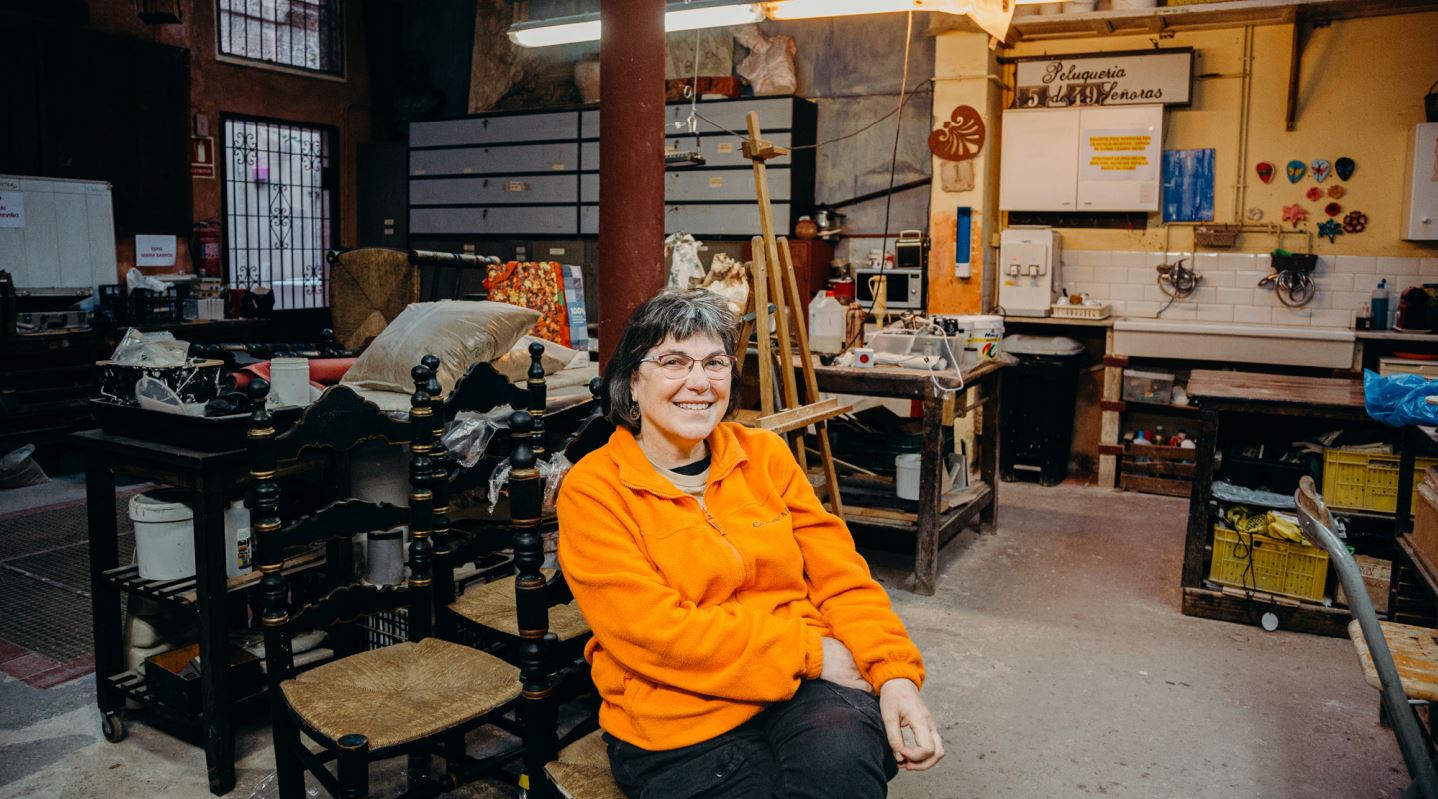
This interview was published in the June 2023 issue of the Guild magazine (you can find it in the Publications web section)
For this issue of the magazine we interviewed Cristina Thió i Lluch, founder of Chroma Restoration of Architectural Heritage, a Guild company that for years has given a lot to talk about for the quality of its work and the passion for the heritage of its founder.
— For those who do not know you yet... what activity does Chroma carry out?
— In Chroma we have a line that almost occupies us between 60%-70% of our activity which is the restoration of historical architectural heritage. It does not have to be catalogued by city councils or the Generalitat because for me all heritage is catalogued, any built heritage that is anonymous or not, is already susceptible to being saved. We do many restorations, from the Baroque to the Noucentisme, being almost 300 years of performance between these centuries. We have also carried out specific medieval works. On the other hand, we have movable goods such as altarpieces or organs. We had had a lot of activity in this area until it went down with the crisis of 2008 and now there is a revival of restoration of paintings, historical furniture of both private individuals and museums. In addition, we do many historical artistic chromatic and lesion studies, which occupy us very well 15-20% and brings us a lot of knowledge and R&D for the company. We know a lot about heritage, traditional materials and techniques, and this means that we have a high capacity to analyze the diseases of buildings and learn about their history. Finally, we have the part of customer advice that could occupy us 5%.
— What motivated you to found Chroma?
— Ever since I was a child I dreamed of having a workshop and fixing things. I started working at the Barcelona City Council, at the Archaeology Museum, I restored the Furniture Restoration Center of the Generalitat de Catalunya... but I wanted to change the world, I wanted to do a thousand things and you go to the administrations very little by little. At the age of 24, three partners and I set up the workshop. To found Chroma was to change the world, to change the way we work, without bureaucratic impediments, and to do it as quickly as I wanted. I wanted to know a lot more and when you're in an administration it's hard to belluge yourself, and that's why we mainly
founded Chroma... to save the heritage.— Why did you decide to dedicate yourself to the restoration of architectural heritage?
— I entered the Fine Arts degree thinking that I would suspend the Architecture degree. I thought I wanted to illustrate. I really liked drawing and in Belles Arts you can go out having made films, engravings, restoration... a thousand things. Of restoration, at that time, I had no idea either. I really like buildings and working wholesale and it was too early to restore paintings or furniture. Buildings are more complicated and if they are poorly restored they end up collapsing. On the other hand, if someone acts badly on their heritage everyone can see it and it hurts the cultural landscape
.— This passion for the craft is what has led you to win prize after award in recent years. Is there anyone who has made you particularly excited?
— The Generalitat Restoration Award made me especially excited because it was a recognition that they give you in your home. It was also the first major award we won. We had submitted to other awards before but we were always finalists. This is when you see that things are on the right track. In 2019 I realized that a recognition began, after thirty years
experience and a lot of effort.
With the award of Richard H. Driehaus in 2021 I stayed in a floating cloud for 3 months, because it is an award that I watched from afar as a spectator. When they called me I thought: Me? I still have a lot to learn! How can I win an award of this caliber? ... We were treated very well, we met fantastic people in love with architecture. It was a wonderful experience. Receiving these awards has gone very well for us, since now you speak and they believe you... these awards obviously make the path more enjoyable.
— In a post that you posted on social networks on March 8, a large group of women workers of the company came out. What do you think about the role of women in the construction industry
?Being a woman is not an impediment, quite the opposite. I bet a lot on women, I always encourage them that when they come to work they do not feel that it is the weak sex and that they need men to help them. They do not need to have an assistant for each of them as it happened before. Now women are independent and if a girl comes here she does not necessarily have to have knowledge of restoration but must want to learn. It doesn't matter to me that I don't have the degree, I learned the Architectural Restoration career here. At Chroma we try to do school, and women tend to have a sensitivity, a delicacy when it comes to work, which is very often different from that of men. Many times they have been fixed and recognize us thanks to the details of these finishes. We give them all easily and I try to enhance them.
I had a lot of impediments, around the 90s, it was a war still being at a play and hearing you take the hair out of men. It was horrible, they often said what was this girl doing here. Many expected a gentleman with a beard, someone serious, the prototype of a restorer, and me with the face of a young girl, who had once again told me the thing of: but have you made a career? Being so young... Yes, it is true that even today for the mere fact of being a woman you have to prove ten times more than you are worth for a job and that has always happened to me in the works... in museums not so much, but in the works it still
happens.I am now 32 years old and it has been a very hard few years, of coming home nervous, of trying to do things 30% well so that if a man did it 10%, they would catch you. Today what I would recommend to women is above all that they want to be self-sufficient and make themselves necessary. You have to be very brave. In a play they need many different profiles and a woman has to lose her fear
.— Chroma is not only dedicated to heritage restoration but also promotes the training of professionals with courses and workshops. What kind of people are they addressing? Is there a course you would recommend for interested companies in the Guild?
— It was very difficult for me to find internships when I was studying. What I wanted to do is try to do in Chroma what it took me a long time to achieve: that people can practice whatever they want. The only impediment is that there are certain restrictions such as that students in internships cannot climb scaffolding since insurance is very complicated in this regard. But I think that this is the most effective way to learn and I was very sorry that the doors were not opened for me in your day and if you were a girl you could not learn a trade even in twenty years. Now I think we do a good job for many students from many areas and since it happened to me that I wanted to illustrate and I ended up doing something else I often encourage them to try different things. Trying to open people's minds is the idea we have here
.We have even worked with people who have been affected by the crisis and after 40 years have changed professions. What is needed is a desire to work, to be a good colleague, to team up and above all to be positive... the rest is learned from the experience of colleagues.
Icurrently teach at the Greta association, which is for the safeguarding of traditional architecture and also at Orígens, a bioconstruction school-workshop where stucco is worked among other things. All with the desire to safeguard the heritage and teach people that you do not have to go to buy the materials abroad but to take advantage of what you have in the territory.
Iwould recommend everyone to go to Greta, in Girona, because it would be very good for them to refresh themselves and not have so much mentality of rehabilitating with imported materials. You have to bet on your own architecture, with our materials, there you learn to dose, to look at the diseases of each building. I would recommend all builders to take advantage when days are done. People need to learn to work with what was there before. There are very healthy buildings built with these traditional materials. You have to know why things were done, why cross ventilation was done, because one pavement was laid and not another... there was a constructive intelligence that currently seems to have been forgotten and I think that anyone who is engaged in heritage restoration or heritage rehabilitation should have more knowledge of traditional construction and materials
.— What do you take into account especially when carrying out a restoration and preserving the cultural and artistic value of the elements of the building?
— First you have to do a historical-artistic study. It is necessary to carry out analyzes of absorption of materials, salts, if it has xylophone insects that are eating it... The need is to know that architecture, as well as the state of conservation to know what kind of surgery you have to do and to know what these layers have hidden, in case you have a jewel of the crown hidden inside or you have a traditional
anonymous architecture.— And when you have different layers, in the end what reefs do you have?
— What you have to value is when it had the most cultural value. An example: we worked in a baroque building in front of the Palau de la Música with a sgraffito that turned out to be by the architect Jujol. Well, in the end you save the graffiti because there are not too many of them in Barcelona. You have to investigate which is the artist who participated, who was the architect or if this building, in the past, during the Baroque, was the most beautiful house that existed in this neighborhood. You have to understand very well what you have to do to know what you save and what you take away. And this is based on many years of experience. Chroma is lucky or unfortunate that I am a restaurateur and I do not look so much at money as at knowledge. Every business has to make money, but my first priority is to learn and teach.
— And what do you think about how things are being done today in building renovations?
— It's not doing all right. I think it has evolved a bit but we are still a long way off, everywhere. Yes, they are forcing themselves to use sustainable materials but people do not differentiate a hydraulic lime from an aerial lime, they dose them badly, they do not know how to apply it because there are no expert craftsmen and they do not wet it too much and then it cracks and they tell you that the lime is bad because it has cracked. There should be more knowledge of materials and their application. The heritage inspectors themselves do not have sufficient knowledge of the history of art or knowledge of materials, they only know that lime should be put in that work but not what type, in what way, with what dosage, dyed in mass or not, painted in fresco or not... it is true that now there is more talk of lime and it is put in buildings, we have evolved yes, but there there is a void of knowledge of why you do things that is quite sad. Knowledge is absent in many places, too much. This ignorance has greatly influenced the energy issue of each building.
— Currently, many campaigns are carried out by the administrations for the energy rehabilitation of buildings. What do you think about energy efficiency elements in buildings? Do they conflict with the values of heritage restoration and conservation
or with aesthetics?— When someone rehabilitates without energy improvements, they only paint the face of that building but when you take care of a building you are a restaurant. My way of understanding restoration is to be that of a doctor in that building. When you stop a disease in a building you are working as a restorer. Old buildings when they want to rehabilitate, whether with subsidies or not, usually add finishes that safeguard them from humidity, heat and cold, this is not restored that is to rehabilitate, you are improving but it is at odds with where do you put this improvement, outside and take off an 18th century facade? or do you put it inside and lose private space for your dining room? I believe very much in investing in R&D, that we can make modern virgin materials from traditional materials, we can evolve a lot. Let people think that the first thing you have to do is remove the carpentry that has been there 300 years, because the ones now are better... there are other solutions without having to throw history out the window. Teams should be multidisciplinary, when someone has to do an intervention in a building and is an engineer they should be accompanied by the hand of the architect, the restorer, the geologist, the chemist, whatever and say: how do we do it? We often try to be multidisciplinary and we try to have people from all over the world to enrich our knowledge. Do you think the time will come
That rehabilitation and restoration will go hand in hand? I think so, because tools are being created to do this and young people come with a more open mindset and I hope and wish that we are on the right track. People should not think badly of a traditional material, for people to want to make clay pavements would be great because you have warmer floors. Sometimes, because these materials are not expensive, they are thought to be worthless. We would have to clear our consciousness of the planet we touch, try to leave it better than what has come to us and everyone should think at least that
— As an association company for a long time, what has been your experience? Do you often work with companies that are also trade unions?
— We are in the builders guild but we are not builders but Heritage Restorers, because we did not have a specific place to locate ourselves, we joined the Builders Guild, we are a rare piece within the Guild, restoring for us is not building but we remake what is built historically. I believe very much in associations and in that union makes strength, I had to join if or if because I believe that we are part of this nucleus that together we must do work. We really need to know with whom we share these associations. I haven't had much time to research what synergies we can make yet but I think we should take great care of these unions
.What projects have you carried out lately? Any particularly prominent or difficult?
— We have carried out many different projects, for example in the Monastery of Cervià de Ter, a medieval monastery where the sand was falling and the stones were falling apart, conservation and maintenance work has been done. We have also recently built a medieval tower where we have set up a magnificent staircase so that people can visit the tower of Cervià itself. A few years ago we moved a very long chimney in Hospitalet because they had to urbanize that floor and that chimney bothered. I was not in the mood to do it because I believed that it was the urbanization that had to move as a new construction, but if I did not I would come another one. At least we learned how that chimney worked. Now we are making modernist facades of an old factory, the modernist grandstands of Rambla Catalunya street, the temple of the consulate of the E.E. U.U which we're about to end... I wouldn't know what I liked most to do,
it is an enriching job in every way, you have the ability to learn every day and the students have the tools not to collapse when they make mistakes and that is why I prefer that when they come here they make mistakes again and again and learn and get the tools to face the mistakes.
— How do you see the future of Chroma and the professionals involved in heritage restoration?
— The future of Chroma now I see very well and now I feel strangely relaxed because things are working. We are at a point that this team is solid and I see relief for me, something that two years ago I did not see and I was stressed by the fact that someone has to continue with Chroma. I'm in a sweet moment. When you talk to people they believe you, they listen to you, when they ask you you already have the tables to answer. There is a much greater implication than before and it gives me time to be more contemplative. After 32 years of suffering a lot to put the company where it is now, I see a good future for it, I see that the world is turning along the path that I once got off track, that path that seemed to be lonely, I see that it is being imposed and it is very satisfactory. These are beautiful days to enjoy. It is the peace of mind that someone will follow this work, more
good or bad, i have carried it my way some will not share my thoughts but at least you know that you have made people want to do a job well done even if it deviates from the path that i led. People need to be aware, get along well with the environment, with houses, buildings... that Chroma DNA is already given and it's time to take a step back and let it grow. What makes me suffer many times is that when you are growing up and you have homework to do, duties that you have set for yourself, to be able to finish them all. I see I've done almost all of them, I still have a few
to do, but now I think the balance is on the positive side. I am happy with what I have contributed and I can sleep peacefully and that is very good
— Do you think Barcelona treats its historical heritage well? What change do you think is essential for the preservation of the city's heritage?
— No, I think Barcelona have won a lot but they don't treat it well. Yes, there is much more knowledge but they still treat heritage in a general way. In the heritage of the 19th century you can find many masters of works, many craftsmen and you cannot globalize a century. Barcelona generally has good people at the helm but there needs to be more knowledge. You cannot globalize the centuries, you cannot globalize cities, you cannot make Barcelona work the same as Girona and Sarrià work the same as in Ciutat Vella... houses are like people, they are not all the
same.The more differences we make and can recreate, the richer Barcelona will be and the more diverse paintings we can visit. Not to speak of a global Barcelona but of an intimate Barcelona. If we bet on this individuality we would have tourist circuits, both for Barcelona and Catalans themselves as well as for foreigners, very rich.
— Considering her long experience as an architectural restorer and knowledge, is there any city, whether national or international, that has seemed to her an example for the rest in relation to her care of heritage?
— Italy is a good reference of ancient architecture, all the ethical and deontological codes of the restorers come from there but in Italy it happens a bit like Barcelona. A year ago I returned to Venice and I always find that I like the buildings that are not touched, these are the ones that transport me directly to the 18th or 19th century and the buildings touched do not show the trace of time, the materials are not the original and it shows. When someone puts mass-made mortars commercialized, you see that that doesn't go there, it has globalized a building. If packaged materials are always used, you end up globalizing the facades and that is what should not be done and I think that in Italy they must have the same problem as in Barcelona. A city, above all, must have an architecture that welcomes you. I have traveled a lot but I have not found a city that says: I would live here. In all of them I find some defect, my eyes are too vicious, and in all of them I find that multidisciplinary teams are missing to decide how to transform these cities. If I have to choose, I stay with the old town of Barcelona.